
/08
MARINA VICTORIA IS AN ARCHITECT AND FOUNDED HER OWN STUDIO IN 2019. HER WORK EXPLORES THE CONNECTION BETWEEN ARCHITECTURE, INTERIOR DESIGN AND ART, DEVELOPING SPACES WITH A CREATIVE AND CONTEMPORARY APPROACH. HER CAREER REFLECTS AN INTEREST IN CREATING ARCHITECTURE WITH A DISTINCT IDENTITY, CAPABLE OF DIALOGUING WITH ITS CONTEXT AND THE PEOPLE WHO INHABIT IT.
“I try to draw inspiration from the architecture and design of other eras, but also from my own intuitions.”

For those who don’t know you yet, Marina, how would you describe yourself professionally, and what are you most passionate about when it comes to bringing a space to life?
I am an architect and the founder of Marina Victoria Studio. I am keen to approach each project from a conceptual and creative perspective, viewing architecture, interior design and design as part of a single process.
What I am most passionate about is the exploration phase of a project. Every project is different and has its own language. I enjoy researching, testing materials and exploring ideas until I find the solution that best suits each project.

What words do you think best describe the concept of your home?
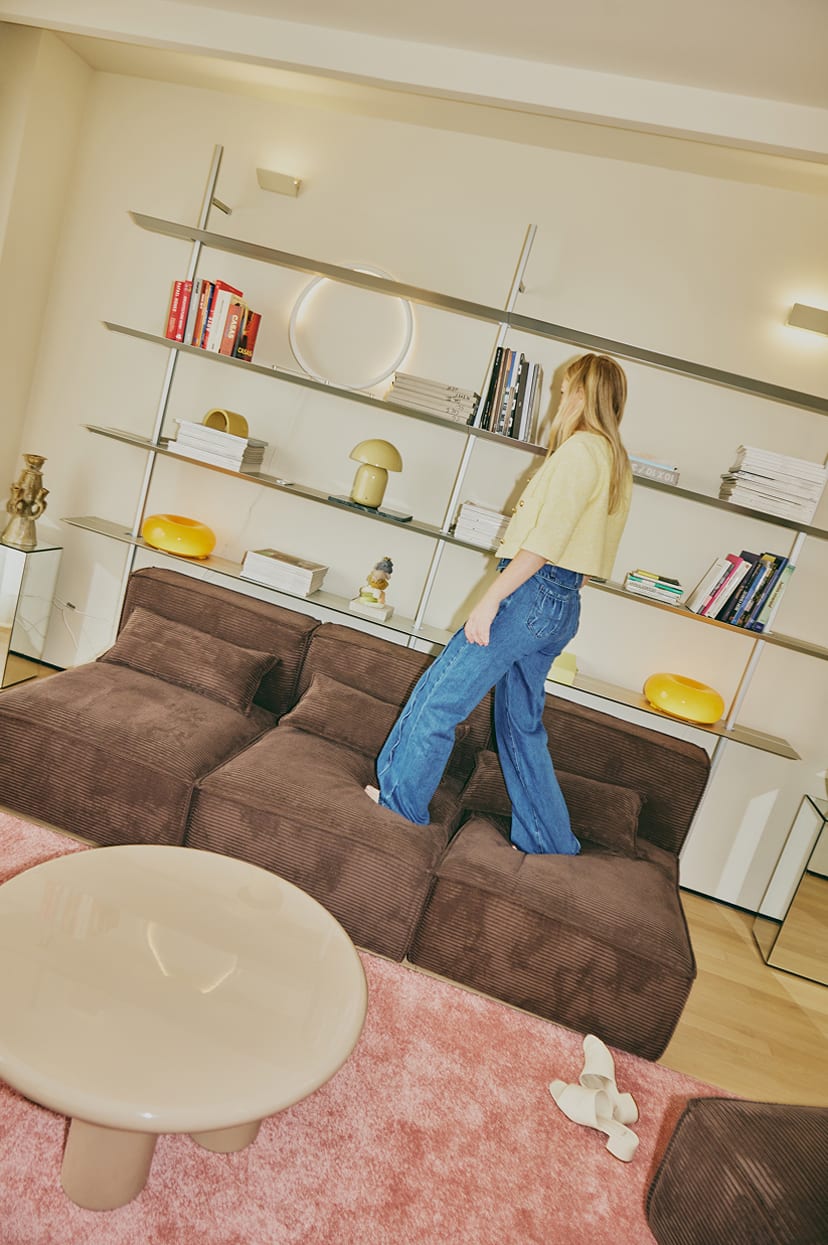
Contrast, balance and harmony. I wanted to create a home where contrasts coexist in a balanced way. There are materials that are very different from one another, striking colours and highly expressive pieces, but they all stem from the same concept.
What’s your favourite spot in your home or your personal sanctuary, and why?
The living room and the kitchen. I like the connection between the two and the fact that you can open them up or close them off depending on the occasion. The curtains transform the space in a very subtle way and mean that the same house can be experienced in different ways. It is also where you can best appreciate the contrast between the materials and the way the light transforms them throughout the day.
What design trends are currently inspiring you, and how do you incorporate them into your home?
It’s inevitable to be influenced by trends, but I’m increasingly trying to ensure they carry less weight in my projects. We live in a time when trends change very quickly, and the information overload means that many lose their value just as quickly as they appear.
I’m far more interested in creating spaces that are based on a solid concept rather than a passing fad. (…)


How important do you think colour is to the experience of a space?
For me, colour makes sense when it forms part of the architecture, rather than when it is seen merely as a decorative element. I am interested in using it as just another material in the project, capable of reinforcing a concept and transforming the perception of space.
How do you decide which objects to include in your space? Is it an aesthetic, emotional or functional decision?
For me, good design always combines these three elements. I look for well-designed objects that stand the test of time and continue to spark the same interest many years later. I’m drawn to spaces with few pieces, but ones that have been very carefully chosen, where each one has a reason for being there.

Which piece of furniture best reflects your lifestyle?
The Parentesi lamp by Flos. I’ve always thought it was a great example of good design. I believe that pieces which go on to become icons do so because they embody a very clear idea and are well executed. It’s those kinds of objects that interest me.
What percentage would you say the choice of furniture accounts for in good interior design?
I don’t think there’s a fixed percentage; it depends very much on each project. There are spaces where the architectural design itself already incorporates much of the furniture, and others where the pieces play a much more prominent role.
What I do think is essential, however, is that the furniture forms part of a whole and reflects the same concept as the rest of the project. When there’s that coherence, everything falls into place naturally. Otherwise, the furniture ends up looking like an afterthought, with no real reason for being there.


Marina Victoria’s 3 tips for creating harmony in the home?
1. Take a look at how you live before you start designing. A home works best when it responds to those who live in it, rather than to a preconceived image.
2. Make decisions based on a set of criteria. Materials, colour, lighting and furniture should not be chosen in isolation, but as part of a whole.
3. Don’t design with the latest trends in mind. A home that reflects the personality of its inhabitants always achieves a more lasting harmony than one designed to follow a trend.
So, what combinations of materials do you like for this season?
At the moment, I’m particularly interested in contrasts: natural stone with metallic finishes, coloured glass with wood, and highly textured fabrics. (...)
Is there any unexpected place that has deeply inspired you in your work?
I believe that inspiration doesn’t usually come from a single source, but rather from many experiences that build up over time. Every journey, every exhibition or every building you visit leaves you with an idea, a material or a different way of understanding space, and all of that eventually becomes part of your own language.

"I believe that the richness of a space often stems precisely from the interplay between very different materials."

Why do you choose The Masie?
Because it offers a wide variety of pieces with plenty of character, capable of adding personality to a project without compromising its cohesion. This makes it very easy to find pieces that fit in with the concept of each space.
What does our furniture inspire in you?
They inspire me to freely incorporate colour, shapes and materials with personality. I believe these pieces have the potential to become the focal point of a space and add that touch of character that often brings a project to life.
If you could take just one design piece from any museum in the world, which one would it be?
One of James Turrell’s Glassworks. I’m fascinated by his ability to transform a space using nothing but light and colour.


The Masie’s favourite track:
The set of iridescent side tables, “Iris”.
A colour:
Pink
Favorite style:
70s design
Countryside or city:
City
References:
Achille Castiglioni, Ettore Sottsass, Sabine Marcelis
Who is your interior design icon?
Patricia Urquiola, for having transformed the way we understand contemporary design through a wide range of disciplines.